Ruled and unruled: the two sides of the work
One series is built on a grid; the other has no grid at all. A close look at what separates Retro Modern Harmony from Clouds of Color, and what they share.
Words by ARTHAUS

Put a piece from each of Shelly Bremmer's series side by side and the difference is immediate. One is made of edges. The other has almost none.
Ruled
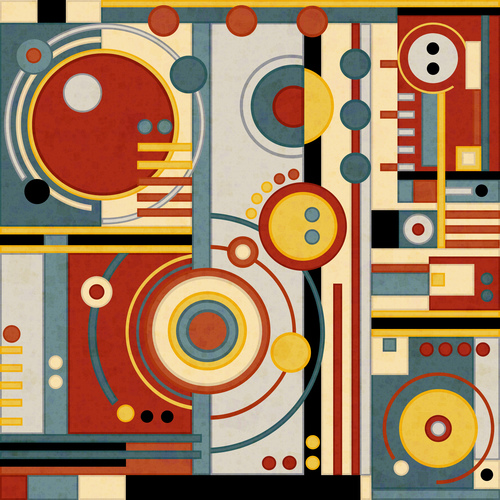
The geometric pieces divide the square into rectangular sections with vertical and horizontal bars, then fill those sections with circles, half-circles, ladders of small squares and rows of dots. In Orbit, large circles and tall bands stand on the left and in the middle while smaller squares gather to the right. Shapes overlap and stack, but everything sits on one flat plane: there is no horizon and no depth, only pattern.
Look closely and the surfaces are not perfectly flat. Many of the coloured shapes carry a fine grain, like a print on textured paper, set against smooth blocks of colour.

Unruled
The fluid pieces drop the grid entirely. In Clouds of Color, irregular patches of red, magenta, cyan and purple interlock with no single focal point; a yellow area holds the upper right and a pale blue mass sits low in the centre. The edges are mottled rather than sharp, so the eye drifts from colour to colour instead of jumping from shape to shape.
What they share
Both series fill the frame to every edge, and both use colour at full strength. The geometric work organises it; the fluid work lets it run. Seen together, they make a good case that the colour is the constant, and the ruler is optional.
Browse Retro Modern Harmony or Clouds of Color.


